
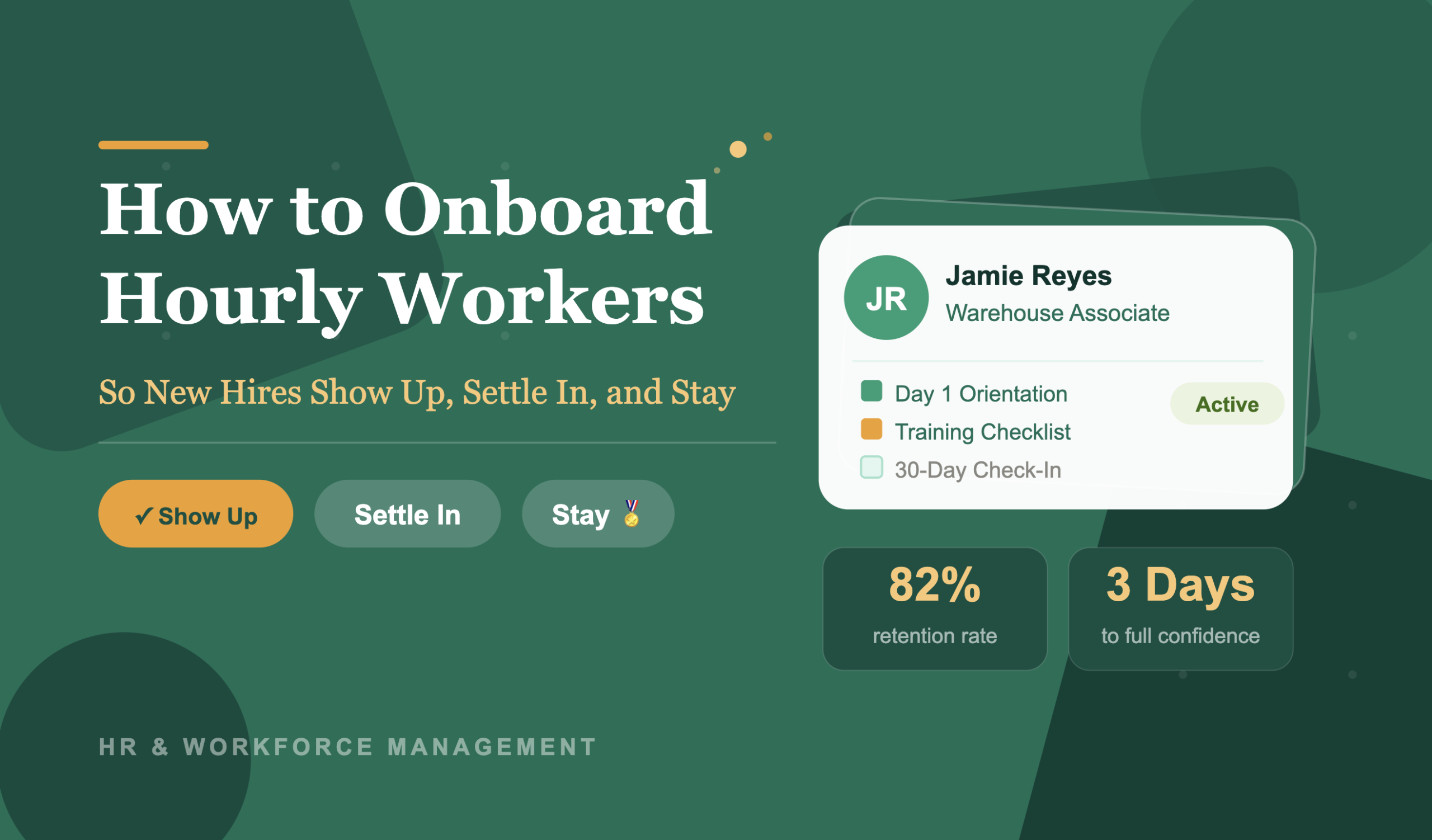
So New Hires Show Up, Settle In, and Stay
By Mona Zander | Founder & CEO, matchAmint
In the first two posts in this series, we looked at why candidates ghost and why many never finish applying. This post picks up where those leave off: what happens after a candidate says yes, when the hiring process still is not over.
You posted the job. You screened candidates. You made the offer. They said yes.
And then somewhere between the offer and the first shift, things got wobbly.
Maybe they never showed up. Maybe they lasted three days and disappeared. Maybe they stayed, but by Day 2, they already seemed unsure.
For employers hiring hourly and frontline workers, this is one of the most frustrating parts of the process. You did the work to find someone. You made the offer. Everyone was ready to move forward.
Then the handoff broke. The good news? The fix is usually simpler than people think.
The Onboarding Problem Nobody Talks About
A lot of employers think onboarding starts on Day 1. For hourly workers, it starts much earlier. It starts the moment a candidate says yes.
That period between offer acceptance and the first shift is where many new hires start making quiet decisions. Do they feel welcomed? Do they know where to go? What to bring? Who to ask for? Does the job still feel real?
When there is silence between “yes” and Day 1, doubt has room to grow.
Gallup found that only 12% of employees strongly agree their organization does a great job onboarding new employees. For small and mid-sized employers, every restart is expensive. SHRM’s 2025 benchmarking data puts the average cost per hire at $5,475 for nonexecutive roles, and that is before counting lost productivity, training time, overtime coverage, and the strain on the rest of the team.
Onboarding is not just an HR task. It is part of hiring. And for hourly roles, it can be the difference between a new hire who shows up ready and one who quietly disappears before the first week is over.
Why Hourly Onboarding Falls Apart
In many organizations, onboarding was designed for salaried, office-based roles. Hourly workers often get a thinner version: paperwork, a quick tour, and an unspoken “you’ll figure it out.” That may be common. But it is not enough.
This applies across many hourly and frontline environments: manufacturing, warehouse and logistics, food service, retail, healthcare support, skilled trades, and other hands-on roles where the first few shifts shape whether the job feels workable.
Three things usually go wrong.
1. The silence between “yes” and Day 1
A candidate accepts the offer and then hears nothing for several days. No reminder. No arrival instructions. No contact person. No confirmation of what to bring.
That silence creates uncertainty. Another offer may come in. Transportation issues may pop up. Or the candidate may simply wonder whether the employer is organized enough to be worth showing up for.
| A short welcome message within 24 hours can close that gap. It does not need to be fancy. It just needs to be clear. |
2. Day 1 is all paperwork, no people
The I-9, W-4, direct deposit setup, and policy forms may all be necessary. But if the whole first day feels like paperwork and compliance, the new hire may feel like a transaction instead of a person.
That matters, especially in hourly environments where workers are often deciding quickly whether the workplace feels respectful, organized, and worth staying in.
A face-to-face welcome from the manager, a simple team introduction, and a clear walkthrough of the first week can change the tone completely.
3. Nobody checks in after the first week
Many employers treat the offer as the finish line. It is not.
Research cited by SHRM has found that up to 20% of turnover can happen within the first 45 days, a period when new hires are still deciding whether the job matches what they expected.
| Up to 20% of turnover happens within the first 45 days. The hiring process does not end at the offer. It ends when someone stays. |
The first 5, 30, and 60 days are when small problems either get solved early or quietly become reasons to leave. A two-minute check-in can catch issues before they become exits.
What Employers Can Do Starting This Week
You do not need a complicated onboarding platform. You need a simple sequence that makes the new hire feel expected, informed, and supported.
Send a welcome message within 24 hours of acceptance
Congratulate them. Confirm the start date. Tell them what to bring. Tell them who to ask for when they arrive. This takes a few minutes and can reduce confusion before Day 1.
| Example: Hi [Name], we’re excited to have you joining us. Your first day is [date] at [time]. Please bring [items]. When you arrive, ask for [person]. We’ll walk you through everything on Day 1. |
Share Day 1 logistics before Day 1
Do not make the new hire guess. Tell them where to park, which entrance to use, what to wear, whether to bring lunch, who their supervisor is, what time to arrive, and who to contact if something changes.
These details may seem small to the employer. To a new hire, they can make the difference between feeling confident and feeling anxious.
Make the first day about people, not just paper
Complete the required paperwork, and build human moments around it. Greet the new hire by name. Introduce them to the supervisor. Show them the break room, bathrooms, exits, and key work areas. Explain what the first week will look like.
Make them feel expected, not processed.
Assign a go-to person
New hires often have questions they do not want to ask the manager. Assigning a buddy, trainer, or go-to person gives them a safe place to ask the basics. That person does not need to be a formal mentor. They just need to be approachable, reliable, and clear.
In unionized settings, check the applicable collective bargaining agreement before formalizing buddy, trainer, or mentor roles.
Check in at Day 1, Week 1, Week 2, Day 30, and Day 60
The check-in does not need to be long. Ask: How is it going so far? Is anything confusing?
Do you have what you need? Is the job what you expected?
The goal is not to create more meetings. The goal is to catch small problems early.
Treat the first 60 days as part of hiring
Hiring does not end when the candidate accepts the offer. For hourly and frontline roles, the first 60 days are where the match is either confirmed or lost.
Widely cited onboarding research has found a strong connection between robust onboarding and higher new employee retention, with improvements reported at up to 82%. The exact impact varies by employer, role, industry, and execution, but the direction is clear: new hires are more likely to succeed when the first 60 days are planned instead of improvised.
If you are tracking time-to-hire but not first-week attendance, early turnover, or 60-day retention, you may be missing the part of the process that matters most.
The Bottom Line
Onboarding is not about adding complexity. It is about focusing on the individual’s experience, not just the administrative one.
simple, structured handoff from offer acceptance to Day 60 can help reduce confusion, otect your training investment, and give new hires a better chance to stick.
| Clear communication. Clear expectations. A real welcome. Early check-ins. No guessing games. Tiny details. Big difference. |
Where matchAmint Fits
Hiring does not end when someone says yes. For hourly and frontline roles, what happens between the offer and Day 1 is where you either build trust or lose it.
matchAmint helps employers make that handoff clearer: simple next steps, better communication, and fewer loose ends between “you’re hired” and “welcome to the team.”
Clear jobs. Clear expectations. Better starts.
That is where good work finds good people.
| Make Your Next Hire’s First Week Easier Download the free New Hire Onboarding Checklist for Hourly and Frontline Roles. It gives you a simple offer-to-Day-60 sequence you can use with your next hire, from the welcome message to Day 1 logistics to early check-ins. Download the Free Checklist Want help improving your hiring handoff? Let’s talk. matchamint.work |
About the Author
Mona Zander is the Founder and CEO of matchAmint, an hourly hiring platform built to connect reliable workers with good employers.
Before founding matchAmint, Mona led businesses and product launches at DuPont, Hewlett-Packard, and Signify (formerly Philips Lighting), where she drove turnarounds, built new markets, and delivered results at scale. A certified Six Sigma Master Black Belt, she holds an MBA from Wharton and a B.S. in Chemical Engineering from the University of Virginia.
As an immigrant who rebuilt her life in the U.S. at age 11, Mona believes hiring systems should work better for the people and employers who need them most.
Connect with Mona on LinkedIn: linkedin.com/in/monazander
Sources
Gallup, “Why the Onboarding Experience Is Key for Retention,” 2018.
Gallup, “Essential Ingredients for an Effective Onboarding Program,” 2019.
SHRM, 2025 Benchmarking Reports, cost-per-hire data.
SHRM, “Reducing New Employee Turnover Among Emerging Adults,” citing O.C. Tanner.
SHRM, onboarding guidance and employee onboarding resources.
Brandon Hall Group onboarding research, widely cited in onboarding literature.
Legal Disclaimer
This content is for informational purposes only and does not constitute legal, HR, tax, or employment advice.Statistics cited are from third-party sources believed to be reliable. Employers should consult appropriate legal, HR, tax, or compliance professionals for guidance specific to their organization, jurisdiction, and workforce.
In unionized settings, employers should review applicable collective bargaining agreements before implementing buddy, trainer, or mentor programs, or modifying onboarding procedures that may affect bargaining unit employees.
matchAmint is an equal opportunity platform and does not discriminate based on citizenship status, national origin, or any other protected characteristic.
matchamint.work | Where good work finds good people.
Part 1: Candidate Ghosting Is Expensive · Part 2: Your Application Is Too Long. · Part 3: How to Onboard Hourly Workers
No responses yet